
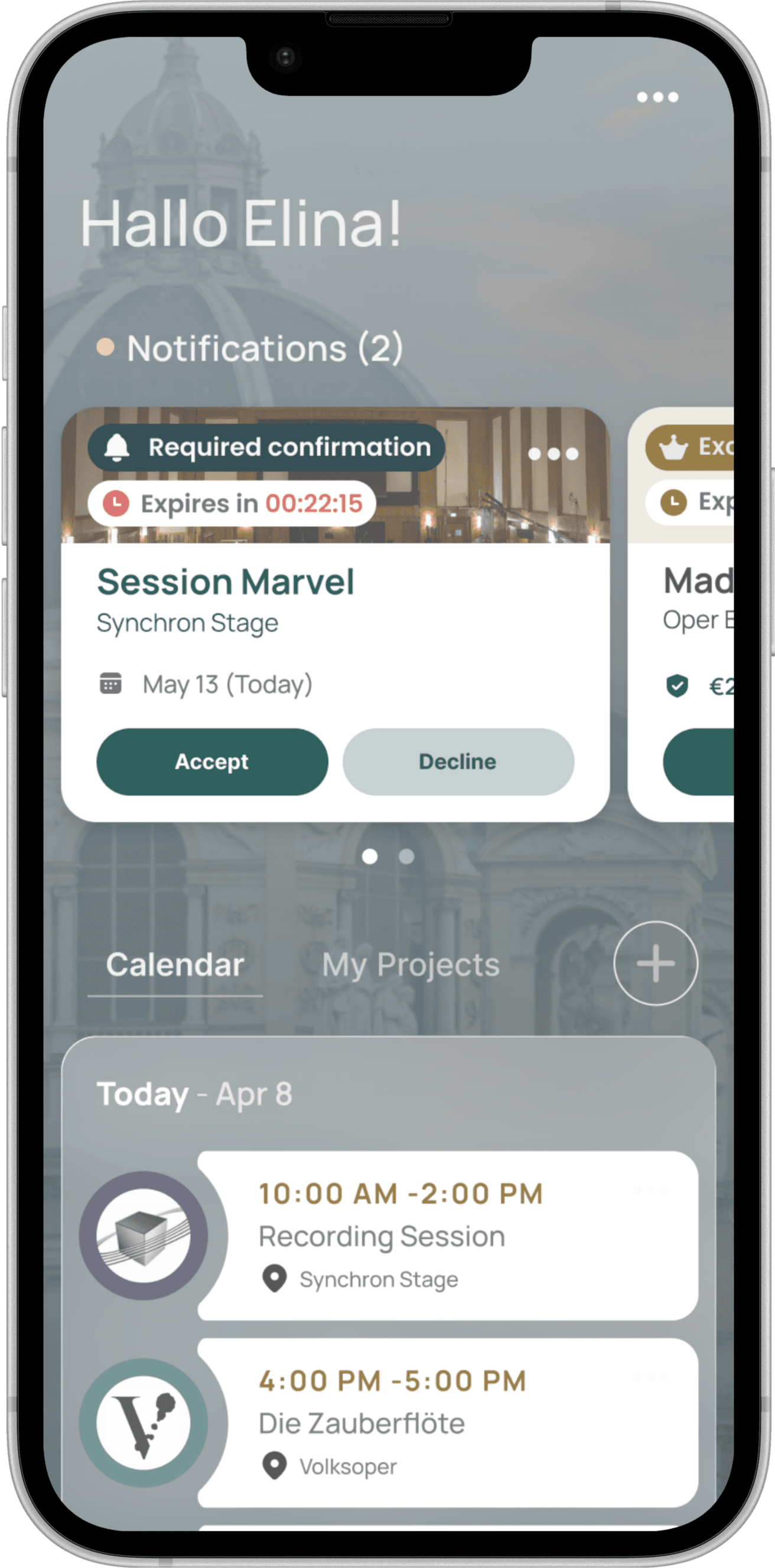
01 - The Problem
If you're a musician just starting out, there's no way to prove you're reliable to someone who's never worked with you. You can't point to a track record. You depend on someone vouching for you. And if you don't know the right people yet, you're stuck.

apps exist, none give musicians a verified track record
apps let musicians build credibility from real attendance data
connection can make or break a musician's career
The original brief:
AI platform that finds and centralizes audition listings across Europe · Free access vs. €59/year paywalls · Scan 500+ organization websites daily
02 - WHERE IT STARTED
This started as something else: a free, AI-powered platform that centralizes audition listings across Europe. I wrote the brief myself, I'm an opera singer, and I live this frustration daily. Then I did the research, and the research had other plans.
03 - RESEARCH: INTERVIEWS
8 in-person, semi-structured interviews at MUK Vienna: 3 orchestral musicians, 4 pianists, 1 opera singer, all current students or emerging artists. All but one were strangers, recruited on campus, so answers stayed honest.
One finding was unanimous: getting hired depends on who already knows you, not how good you are.
"If all opportunities were in ONE database, super great!"
Baritone singer
"Have to re-enter information each time."
Percussionist
"Why should I pay YOU when I'm providing the service?"
Violinist
04 - RESEARCH: COMPETITIVE ANALYSIS
15 apps. None of them can prove you'll show up.
I reviewed 15+ platforms, then went deep on the four musicians actually use: YAP Tracker, Audition Cafe, Audition Oracle, Musical Chairs. All of them are listings. None of them are proof. Paywalls lock students out, most have no mobile app, Europe is an afterthought. The gap wasn't a missing feature. It was a missing category: verifiable reliability.


05 - RESEARCH SYNTHESIS
The interviews pointed somewhere the brief didn't. A centralized database fixes an inconvenience. A verified track record fixes a career.
So the project pivoted: from finding opportunities to proving reliability. Two gaps became two scores.
Almost every musician said the same thing: “It’s not about how good you are. It’s about who already knows you.”
08 - persona
Every decision was tested against Sofia.
The interviews produced four distinct types of musician, each locked out of work in a different way. Sofia became the primary persona, the informal gig seeker with no platform, no network, and no way to prove herself. If a feature didn't help Sofia get hired and show she can be trusted, it didn't ship.


09 - INFORMATION ARCHITECTURE
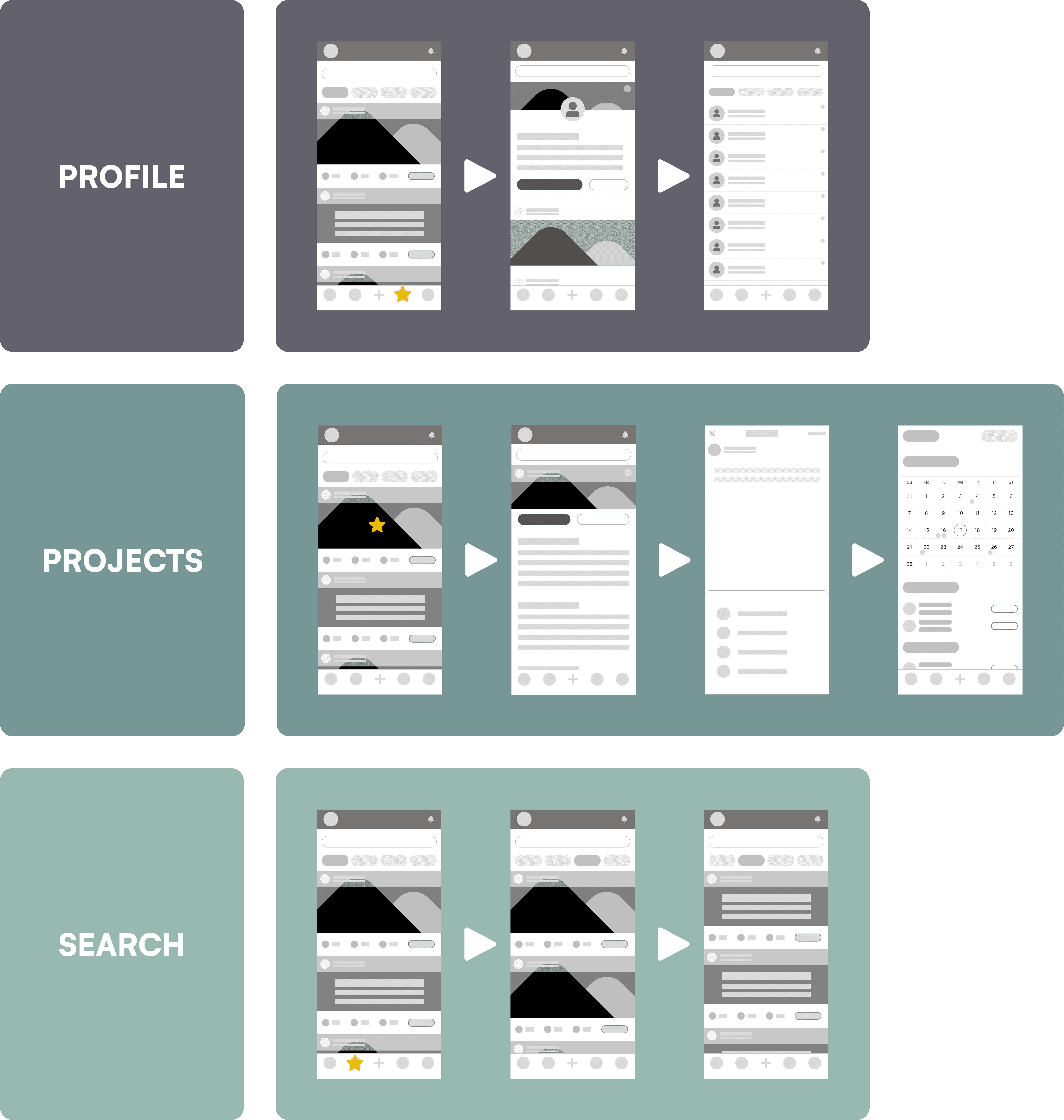
The app follows one loop: find or receive an opportunity, confirm it, show up, and let the record build itself. The sitemap maps that loop into pages: Home, Search, Projects, Chat, Profile. The flows below show it in action: creating an account, searching for an audition, and publishing a gig, each one fast, because musicians abandon anything that feels like paperwork.

10 - WIREFRAMES & ITERATION
Ran the sketches through Stitch to explore direction fast.
Two rules survived into the final build: the reliability score lives on your profile, and match lives on results, it changes with every search.
Invitations moved to the top of Home. When someone asks for you, it shouldn't hide under a search bar.

11 - THE SOLUTION
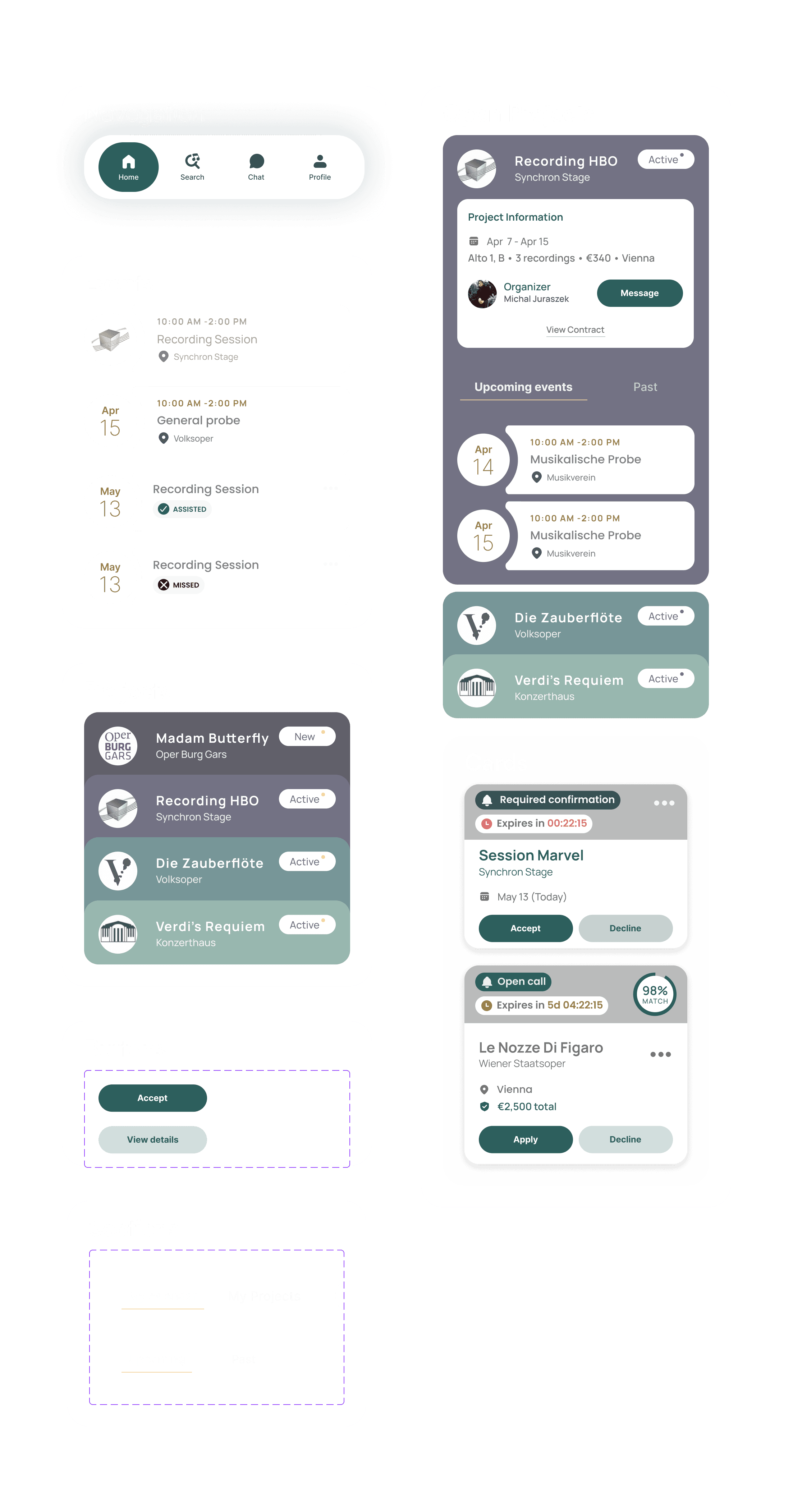
When you accept a gig, the app tracks it. Show up, it records it. Cancel, it records that too. Over time, that builds into something real: a reliability score nobody can fake, manipulate, or write their way out of.


12 - USABILITY TESTING & REVISIONS
I tested in two rounds: group walkthroughs of the mid-fi wireframes across five sessions, then moderated, think-aloud sessions in person.
Everyone finished every task. But watching them, the gaps were obvious, they hesitated, backtracked, and asked questions the interface should have answered.
Every hesitation became a fix.
12
issues found across testing
8
fixed before this version
100%
task completion in moderated sessions
Task 01
Accept an invitation, then confirm attendance for an event inside that project.
Task 02
Find a missed rehearsal and upload a note about it.
Task 03
Explain both scores in your own words.


13 - ROADMAP
Reliability data only means something if musicians generate it first. So the roadmap starts with them.
Some testing issues were fixed immediately. Others were deferred on purpose and they're here, not hidden.
NOW
Musician MVP
Profile with reliability score
Invitations + attendance tracking
From testing: clearer navigation cues, dropdown descriptions
NEXT
Organizer side
Post gigs, manage bookings
Organizers get a track record too
From testing: "Promote My Concert" musicians posting their own events
LATER
Beta & beyond
Beta with the Vienna music scene
Expansion beyond classical






Headline MD
Headline MD
Manrope bold titles 20px
Body LG
Second Text Important topics. 16 px
Body LG
Designed with a focus on negative
space and editorial breathing room. 14 px
Body LG
Small notes or information. 12 px
14 - BRANDING
Overture is the music before the show, the moment everything comes together before the curtain rises. That felt exactly right for an app that connects people before the performance happens.
Font
Manrope. Clean and easy to read at any age.
Colours
Inspired by Vienna. Navy from the Staatsoper, cream from Schönbrunn, gold from the Musikverein, teal from the Palace gardens.
Research showed musicians are sensitive to colour, loud palettes feel stressful. Everything here was chosen to feel calm.
Overture began as a bootcamp project. Now it's being built for real with a team of collaborators. The musician side is designed and done. The organizer side is still being shaped through research, that's a whole separate story.
This version is about one thing: giving musicians a way to get hired based on what they've actually done, not who they happen to know.
Score you can trust
Built from real attendance data. Every gig, every rehearsal, every cancellation counts.
Right fit, not just available
Match score means you show up where you actually fit, not just anywhere there's an opening.
Fair for both sides
New to the scene or not, your profile speaks for you.

16 - Learnings
One score wasn't enough
Reliability and fit are different things. Combining them into one number made both useless.
Finishing doesn't mean understanding
Everyone got through the flows. Two people were still confused about the basics. I almost missed it.
The best idea came from a participant
The colour system that makes everything clear? A participant suggested it mid-session. I just wrote it down.
Obvious to me, confusing to everyone else
Projects vs Events was obvious to me. Nobody else saw it that way at first. It took iteration.
With Stitch, describe the feeling
Short, evocative prompts always got better results than long detailed specs.
I learned that making something feel trustworthy is just as hard as making it easy to use. People can figure out how your app works, but if they don’t believe what it’s telling them, none of that matters.