Platforms give artists uploads. Not reasons to collaborate.
Leep Audio gives independent artists a reason to collaborate, not just a place to upload. Competitions leads the way.

ROLE
UX/UI & Brand Designer
PROBLEM
Artists don't reach out cold. There's no platform giving them a reason to start.
WHAT WE BUILD
The Globe, Collaboration Hub, Competitions, Profile & Analytics.
01 - The Problem
Upload isn't a reason to connect.
Nobody reaches out to a stranger cold. Not for music, not for money. Vampr matches and leaves you in a blank thread. SoundCloud lets you upload and hope. The algorithm surfaces whoever's already famous, everyone else waits. Leep Audio came to us with one question: how do you get independent artists to actually collaborate?

It's not a discovery problem. It's a motivation problem.
"I feel like we're also tied to the chains of the Spotify algorithm."
Alexa, Emerging Artist
"I always like to ask people out for a coffee first, before talking about anything creative."
Gio, Songwriter
02 - RESEARCH: INTERVIEWS
Trust came before talent.
We sat down with musicians, producers, and listeners, not to validate the brief, but to understand how trust gets built before anyone shares a stem. Every conversation circled back to the same wall: the algorithm. Nobody was asked about Spotify. Everybody brought it up anyway.
03 - RESEARCH SYNTHESIS
One wall, five different reasons to hit it.
Every interview kept circling back to one thing: the algorithm. But the reason changed each time. Fans couldn't find new artists. Artists couldn't get seen. Producers couldn't build trust fast enough to collaborate. So we mapped it before touching a single wireframe.
The algorithm problem is universal
Collaboration is open, but on their terms
Curation is non-negotiable
Authenticity decides everything
04 - Research: Competitive Analysis
We studied 16 platforms
Every competitor failed for the same handful of reasons, approval bottlenecks, paid voting that kills participation, blank screens for new users, connections that go nowhere. We mapped every failure to a design decision. That became 7 principles, checked against every screen we built.


05 - BRANDING
Music doesn't belong to one person. It belongs to the universe.
Leep needed to feel like open, infinite, boundless. A place where a song starts with one person and ends up shaped by hands from anywhere on earth, or beyond it.
06 - SOLUTION
Three ideas. One reason to start.
Discovery, collaboration, and reach, each needed its own reason for someone to make the first move. Three ideas came out of research, each proposed by us and built by the client.
Discovery, the geographic globe
Pick a location, hear independent artists from there. No algorithm, no popularity filter. Gio said it best: "On a map, amazing. Like a community."




Collaboration Hub, Stem Request Flow
Unlock a section, write a one-line intent, submit. Artist sees your history before deciding. Approve or decline in one tap.
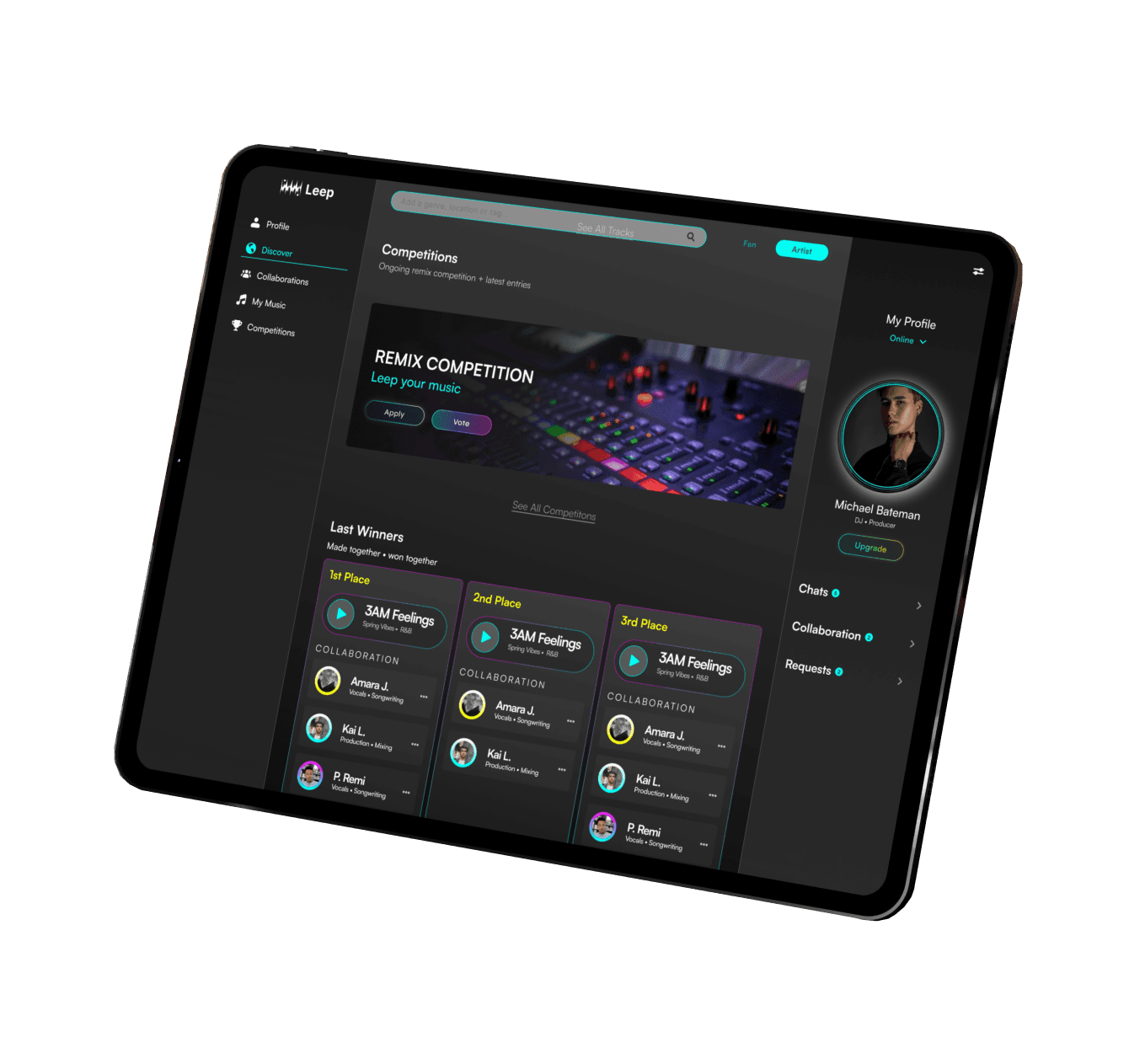
Competitions
Artists don't reach out cold. Competitions gave them a reason, shared track, clear rules, real prizes.
07 - lo-fi WIREFRAMES
Five screens, before anything looked real.
We wireframed the core loop first, Discover, Profile, and My Music, before touching any visual design. Desktop only, matching how the client's users actually work. Every structural decision got tested here before it became a pixel.

08 - Hi-fi & Iterations
The globe wasn't the first draft.
Testing reshaped this screen before it shipped. We didn't keep the earlier versions, but every change is documented here, tied back to what testers actually said.

1
Sections changed and edited after testing the flow
2
Shuffle option and Discover added after testing
3
Too much information felt overwhelming to testers

4
Too much info under the photo. Reorganized and reduced it.
5
Added a 3-section menu to divide the rest of the profile.
09 - PROTOTYPE
Not slides. Something you could click through.
Three tasks, tested live on the working prototype: finding an artist to collaborate with, turning collaboration on or off for a track, and sending a mini remix to break the ice. Every flow testers actually walked through, not just looked at.
TASK 1
Find an artist to collaborate with, and send a request on one of their specific songs.
TASK 2
Go to one of your tracks and turn off "open to collaboration."
TASK 3
From a track you saw on the newsfeed, go to your Music section and send a mini remix to break the ice.
10 - RESULT
We proposed features. The client built them.
Complete high-fidelity UI for Discovery, Collaboration, Competitions, Profile, and Analytics. Real freelance work. Real client. Real decisions that shipped.
Competitions solved the collaboration problem
Artists finally had a reason to engage with a stranger's work. Structured goal, well paced. Proposed, validated in every interview, implemented by the client.
The globe changed discovery
Emerging artists findable from any location. No algorithm deciding what's worth finding. Proposed, validated, implemented by the client.
Testing closed every loop
Every fix-it-immediately item from usability sessions is resolved in the delivered screens.

11 - Learnings
Four things this project made honest.
Research has to be allowed to override the brief
The two features that shipped weren't in the original brief. They came from interviews. Research doesn't just validate ideas it finds the ones you wouldn't have had.
A team that isn't a team is still your responsibility
Three designers assigned. One disengaged. The work still had to be done. Scope doesn't shrink when a collaborator disappears.
Client literacy is a design skill
Leep Audio was unfamiliar with UX process. Every deliverable had to be written in plain language. Design that can't be understood can't be implemented.
Testing changes designs, not just validates them
We killed a feature, renamed two sections, moved three elements, and made one field mandatory. All from real usability sessions.
"Getting people to collaborate. Design the reason to start, and everything else follows."
